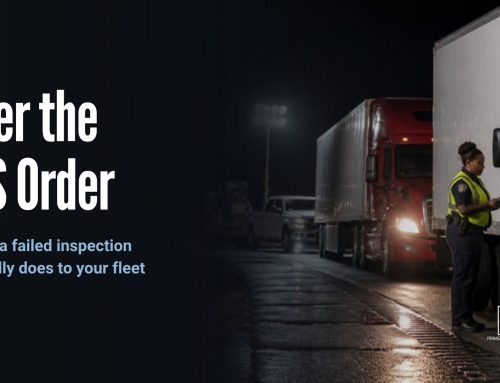
Ask most fleet owners what they worry about at a DOT roadside inspection and they’ll tell you about paperwork. The registration, the insurance card, the permit book, the bill of lading. Those documents matter, and an inspector will ask for them. But they are not what decides whether your truck leaves the scale house or sits there until a mobile mechanic shows up. In a DOT roadside inspection, the decision is usually made before the inspector ever opens a folder.
The Commercial Vehicle Safety Alliance released the results of its 2026 International Roadcheck on August 25. Inspectors conducted 54,575 inspections across the United States, Canada, and Mexico in 72 hours. They placed 10,350 vehicles and 3,184 drivers out of service. Nineteen percent of every vehicle inspected did not finish the day on the road. Almost none of those out-of-service orders were written for a missing document.
What a Level I DOT roadside inspection actually covers
The North American Standard Level I inspection is a 37-step procedure. It is the most thorough inspection an officer can perform and the one most likely to produce an out-of-service order, because it covers both the driver and the full mechanical condition of the vehicle. Level II is a walk-around without the under-vehicle steps. Level III is driver-only. Level V is vehicle-only, usually at the carrier’s terminal.
Here is the part most owners miss: the inspector’s procedure does not start with your documents. It starts the moment your truck rolls onto the scale. Before the officer says a word to your driver, they have already watched the approach, listened to the air system, looked at the tires, and noticed whether a marker light was out. The credential check is where the paperwork gets reviewed. It is not where the inspection begins, and it is rarely where the trouble is.
The walk-up: what inspectors check first
An experienced inspector reads a truck from thirty feet away. Tire condition, visible leaks, cargo that has shifted, a trailer sitting unevenly, a driver who takes too long to find the ELD display. None of that requires a document. All of it shapes what the inspector does next.
Then comes the part of the inspection that fills the out-of-service ledger. In the 2026 Roadcheck, brake system violations were the single most cited vehicle out-of-service violation at 3,379, or 24.3 percent of the total. Add the 2,072 violations for 20 percent defective brakes and brake-related findings accounted for 5,451 out-of-service violations, 39.1 percent of every vehicle taken off the road. Tires ranked second at 2,914. Cargo securement, this year’s named focus, produced 1,724. Lighting produced 1,659.
Notice what is not on that list. No registration. No insurance. No permit book. The five categories that grounded the most trucks in North America this year are all things an inspector finds by looking, crawling, and measuring. If your brake inspection prep is an annual event instead of a weekly habit, the paperwork in the cab will not save you.
The driver side: the medical card surprise
The driver results in 2026 told a story most fleets have not caught up to. For years, hours of service was the top reason drivers were placed out of service. This year it fell to second. The number one driver out-of-service violation in the 2026 Roadcheck was operating without a valid medical card, with 1,072 violations, more than one in four of all driver out-of-service orders. No CDL ranked third. English language proficiency appeared in the top five for the first time.
A medical card is a piece of paper, so this sounds like a paperwork problem. It is not. It is a tracking problem. Since the June 2025 medical certification integration, examiners transmit results electronically to the state licensing agency, and a lapsed or unposted certificate can downgrade a CDL at the state level without anyone at the carrier being notified. The driver hands over a license that looks fine. The inspector runs it. The system says otherwise. That is not a document the driver forgot. It is an expiration nobody at the company was watching.
What an out-of-service order actually costs
An out-of-service order is not a fine. It is a stop. The truck does not move until the violation is corrected on site or the vehicle is towed, and the driver does not move until the driver condition is resolved. For a small fleet that means a load that misses its window, a customer who hears about it, a repair at roadside rates, and a driver on the clock producing nothing.
Then the inspection report posts to your Safety Measurement System profile. Out-of-service violations carry the heaviest severity weights, and a single bad Level I can move a small carrier’s percentile in the Vehicle Maintenance or Driver Fitness BASIC more than a large carrier would ever feel. That percentile is what your insurer, your shippers, and the next inspector who runs your DOT number all see. If the violation was recorded incorrectly, you have a path through the DataQs process. If it was recorded correctly, you have a maintenance program problem that a dispute will not fix.
Preparing for a DOT roadside inspection every day, not the week before
The fleets that pass Level I inspections are not the ones with the neatest permit books. They are the ones where somebody owns three things every single week: the pre-trip and post-trip inspection process is real and the defects get fixed, the maintenance intervals are scheduled and documented before a component fails, and every driver’s medical certificate, CDL status, and Clearinghouse standing is tracked against a calendar instead of discovered at a scale.
That is the Manage phase of the PFM Framework, and it is the phase where roadside outcomes are decided. Plan and Build set the program up. Manage is the daily discipline of running it: expirations, inspections, coaching, and the unglamorous work of catching the cracked drum before the inspector does. The paperwork is the easy part. The condition of the truck and the status of the driver are what the inspector is actually there to check.
Find out where your program stands before an inspector does
Prime Fleet Management gives CMV operators a full DOT Safety and Compliance Team, including a Compliance Manager, HOS Specialist, Safety Specialist, and Admin Assistant, without the cost of hiring in-house staff. That team owns the tracking, the maintenance documentation, and the driver qualification work that keeps trucks moving through inspections.
The place to start is a free DOT Compliance Assessment. It takes about 15 minutes and produces a 12-page report that identifies the gaps in your current safety and compliance program across five FMCSA categories, names the specific regulation behind each one, and totals your maximum penalty exposure under the 2025 FMCSA Civil Penalty Schedule. The report is yours to keep whether or not you work with us.
Book your free DOT Compliance Assessment, or call (855) 838-7051 to talk with the team at primefleetmanagement.com.