Your Safety Director Handles OSHA. Who Handles DOT?
Most construction companies take safety seriously. There is a safety director or a safety manager, a training calendar, toolbox talks, and a binder for every job site. But ask who handles DOT compliance for the construction company’s trucks, and the room usually goes quiet. OSHA and EPA have an owner. DOT often has nobody, and DOT is the one that can park your trucks and stop the work.
This article walks through what DOT compliance for construction companies actually involves: not the renewals once a year, but the work that happens every day, every week, and every month, and who has to do it.
Why DOT Compliance for Construction Companies Gets Missed
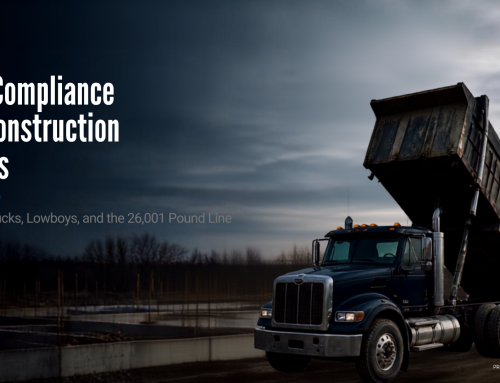
A construction company is not a trucking company, so it rarely thinks of itself as a motor carrier. But any vehicle or combination rated at 10,001 pounds or more used in interstate commerce is a commercial motor vehicle, and the Federal Motor Carrier Safety Regulations apply. That includes the dump trucks, the service trucks, the bucket trucks, and the pickup pulling a skid steer on an equipment trailer.
The safety director is usually focused on the job site: fall protection, trenching, equipment, and the OSHA log. Those are full-time jobs on their own. DOT is a different rulebook with its own records, its own deadlines, and its own daily work.
What DOT Compliance Looks Like Every Day
Here is the part most owners never see. DOT compliance is not a few filings a year. It is a steady stream of small, skilled tasks:
- Every driver’s logs, every working day. Someone reads the hours of service records from the ELD, decides whether each finding is a real violation, an allowed exemption, or a log that needs correcting, and gets it fixed.
- Every speeding and hard-braking event. Someone reviews it in context and coaches the driver before it turns into a crash.
- Every defect a driver reports. Someone follows it until the repair is made and certified.
- Every expiration date. Medical cards, yearly driving records, Clearinghouse queries, annual inspections, registrations.
- Every new driver. A qualification file with an application, a drug test, a Clearinghouse query, a road test, driving records from every state, and safety history from every past employer for three years.
Our How PFM Works page estimates this workload for a fleet doing the work by hand. At 12 trucks, it comes to about 129 hours a month: roughly 264 driver log days to review, 60 safety events, 156 fuel purchases to match, and 84 expiration dates to track. That is about three-quarters of a full-time job, and it takes four different specialties.
Who Has to Do the Work
A complete DOT compliance program needs four kinds of skill. Most companies have none of them on staff:
- A Compliance Manager who owns the program, clears each new driver to drive, makes the judgment calls, and answers for the whole thing.
- An Hours of Service Specialist who reads every driver’s hours every working day and coaches the patterns before they become citations.
- A Safety Specialist who reviews driving events, runs the drug and alcohol program, keeps the accident register, and reviews every roadside inspection.
- A Compliance Admin who keeps the filings, maintenance files, permits, and renewals on a calendar so nothing lapses.
Without someone owning each piece, every piece becomes “somebody’s job,” which means no one’s. That is how a medical card expires on a Saturday and gets found at a roadside inspection on Monday.
DOT Compliance for Construction Companies Is a Plan, First
The first phase of the PFM Framework is Plan: know which rules apply, to which drivers, on which trucks, before an inspector tells you. For a construction company, that starts with an honest look at the fleet: which vehicles reach the 10,001-pound line, which need a CDL driver, and which records already exist.
From there, the work becomes a rhythm. Logs and events every day. Follow-ups every week. A compliance report every month. A review every quarter. Driver reviews, Clearinghouse queries, and a mock audit every year.
The Real Cost Is Time
Most owners do not run out of money for compliance. They run out of hours. The work lands at night, after the crews are home, or it does not get done at all. Either way, it is time away from bidding work, running jobs, and being home.
That is the real trade. Every hour spent matching fuel receipts or chasing a past employer is an hour not spent on the business you built, or with the people you built it for.
Prime Fleet Management is an outsourced DOT safety and compliance department: a full team that does this work every day, for less than it would cost to hire that same team yourself. Your safety director keeps the job site. We take DOT.
Not sure where your fleet stands? Book your free DOT Compliance Assessment. It is about a 15-minute phone call, and you get a 12-page report on your gaps.